
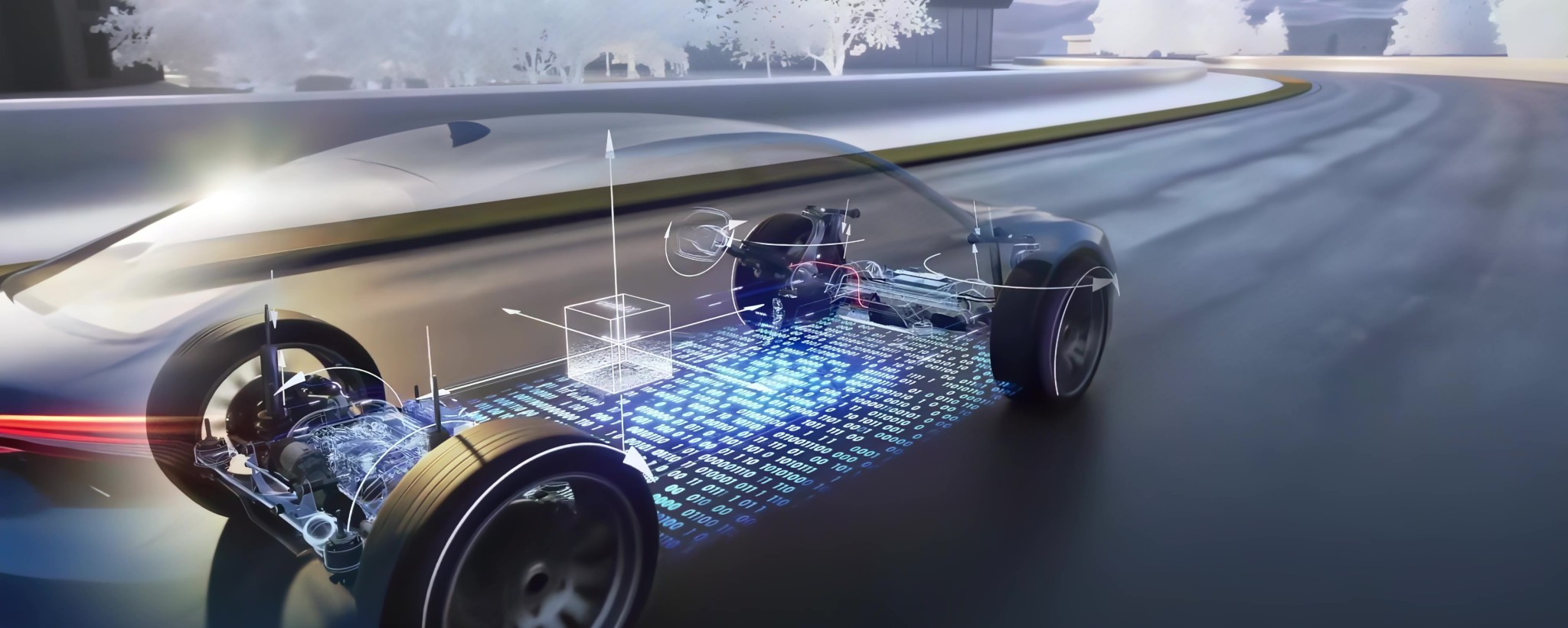

Chassis 2.0 – ZF’s Solution for the Software-defined Vehicle
ZF connects and controls its broad portfolio in chassis development: from smart actuators and software solutions to highly integrated chassis.
Chassis 2.0 is an advanced concept in automotive chassis design that integrates smart technologies and scalable electronic/electrical (E/E) architectures to support software-defined, automated, and electric vehicles. It provides a highly integrated, software-driven system by offering enhanced performance, safety, and comfort.
Much has been written about the transformation of the automotive industry, with terms such as 'software-driven' and 'electric mobility' frequently used. One keyword rarely mentioned in this context though is the chassis. Yet the new drives and electronics architectures, the ever-better assistants and consistently higher level of automation will help shape the chassis for the next generation of vehicles. "Everything comes together in the chassis," says André Engelke, Managing Director ZF Race Engineering. "Smart actuators like braking, steering, and damping bring the vehicle's intelligence to the road. Moreover, electric drives integrate with the chassis more efficiently than internal combustion engines ever did."
The Chassis of the Future: Highly Modular
The choice significantly impacts chassis development. By using software to control the interaction of brakes, steering, shock absorbers, and similar components, vehicle handling can be optimized far beyond what individual hardware components can achieve. This allows designers to elevate safety and driving dynamics to new heights. The same chassis can deliver sporty driving with direct steering feedback or, with autopilot engaged, provide a smooth ride by isolating occupants from road bumps and the way of vehicle‘s motion for a comfortable ride.
This type of driving comfort will even be the decisive factor for passengers to accept and appreciate highly and later fully automated driving. Above all, it is important to master the vertical dynamics. Thanks to various systems, ZF has an enormous range of actions here, depending on whether the semi-active damping CDC or the active sMOTION is used, or whether there is also roll stabilization (ERC – Electromechanic Roll Control) or air suspension on board.
Coordinated actuation of all systems is becoming vastly more important. "The Chassis of the Future is Code" was how ZF described this process a few years ago. ZF took this as the starting point for its cubiX chassis control algorithm, one of the first pure software products on the market today. There are also new electronics architectures that enable interaction with a software-driven architecture via host computers and functionally defined domain controllers. Service-oriented, cloud-based architectures that support updates of new advanced driver assistance systems through to automated driving functions underpin this development.
Opportunity for System-Integration
What does this mean for chassis mechanics? Control arms, dampers and suspension will still be key components, "Chassis 2.0" makes alternative chassis concepts possible. ZF, as system supplier, is advancing these concepts, combining all systems that make up a software-defined vehicle can be combined in a separate substructure, for example.
Chassis 2.0 Meets All Chassis Trends
ZF brings together its response to these developments and requirements under the keyword "Chassis 2.0." ZF covers three potential fields of application for its customers: First, ZF meets more than virtually any other technology company the consistently high demand for smart chassis actuators to control longitudinal, lateral and vertical dynamics. "Vehicle Motion Control is one of our strategic action fields," says Engelke. The portfolio includes the latest-generation Continuous Damping Control and also the active damping system sMOTION, the electrically controlled air suspension, state-of-the-art brake and steering technologies as well as an integrated height sensor that can collect relevant mobility data while the vehicle is moving. Secondly, if you are looking to integrate chassis functions based on the modified E/E architecture of today's passenger car generations in a chassis domain controller or even supplement these functions with software functions, ZF has the solution – particularly with its integrated cubiX chassis control software. Thirdly, ZF offers groundbreaking chassis concept solutions for autonomous electric vehicles used flexibly for commercial applications.
The chassis and its further development are decisive for the successful transformation of the automotive industry. ZF is also leading the field in this area: By migrating, and re-structuring the application software from the actuator to a centralized controller, ZF is capable to provide a holistic chassis level system solution with high modularity, flexibility and scalability for the era of SdV.