Digital Twin: The Future Inside the Computer
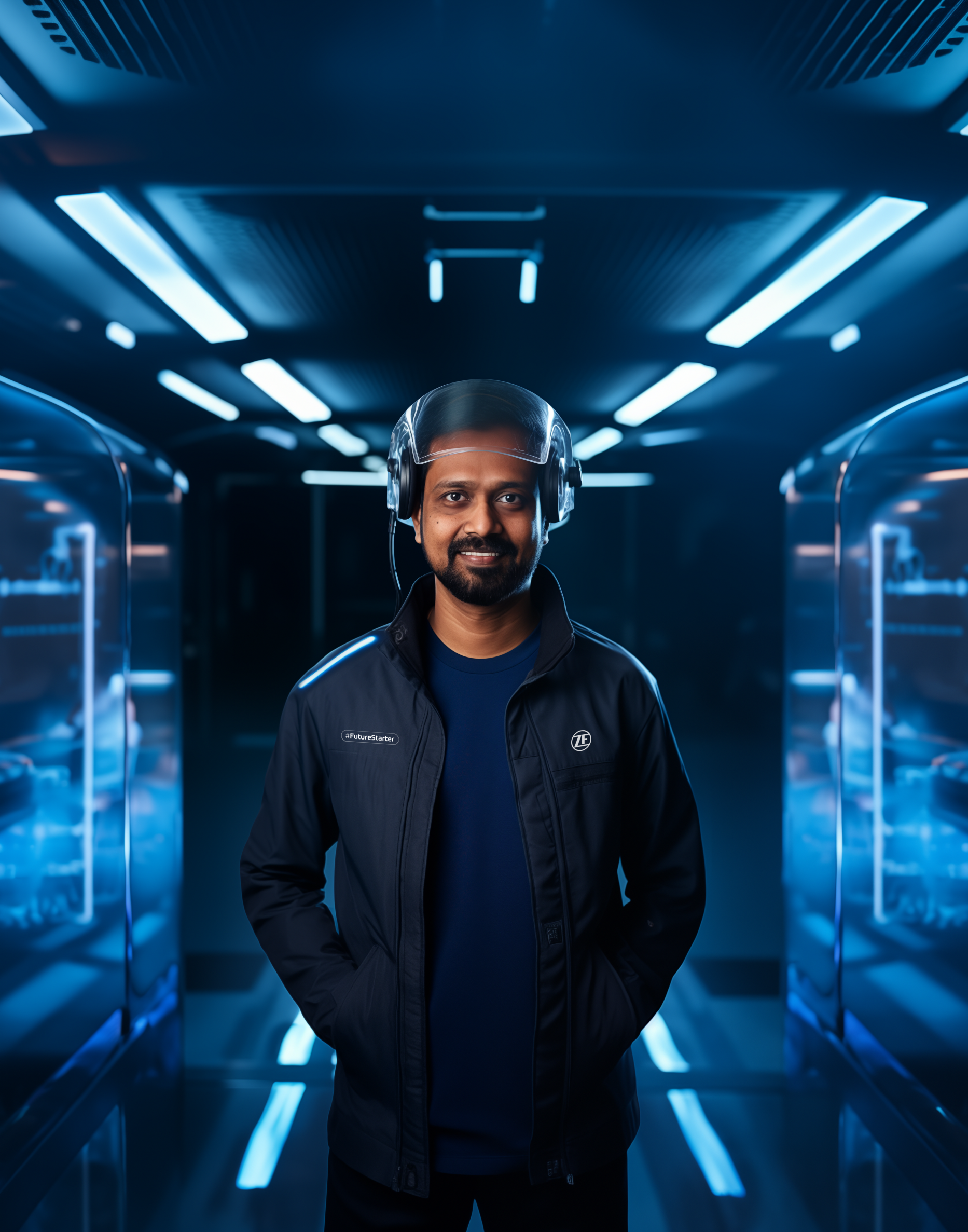
FutureStarter Deevakar Kuppuswamy is impressed by the speed with which ZF is implementing Next Generation Mobility. Together with his team, he is reducing the development times of new transmissions or electric motors by up to half thanks to simulations, virtual approvals and digital twins.
Mechanics and mobility have fascinated Deevakar since his youth, when he was as passionate as he was successful in tuning his 49 cc to a 90 cc moped. The intensive study of mechanical processes and their optimization played a major role in his decision to study mechanical engineering at the University of Madras. Even today, his interest in mechanics remains undiminished: “The laws of physics that allow us to drive cars and motorcycles haven’t changed. But digitalization helps us to better understand which adjustments are needed so that the mechanical processes of an engine or gearbox are as efficient as possible.”
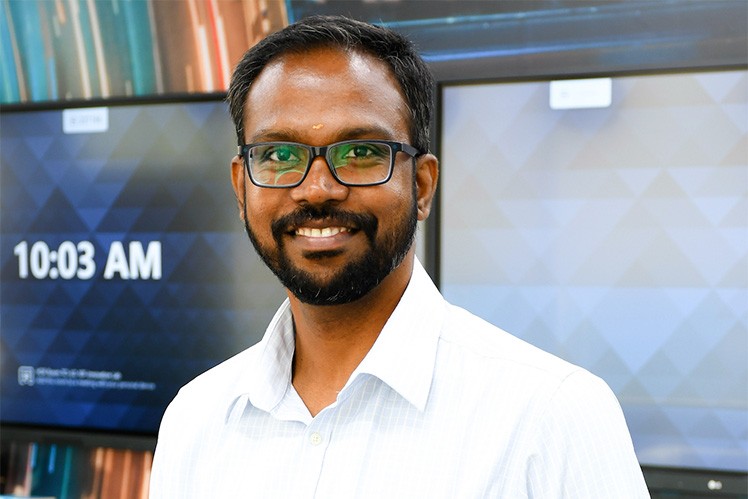
Deevakar Kuppuswamy, head of the department “ZF TCI Systems, E-Motor & Innovation”
Virtual Instead of Physical Prototypes
Just a few years ago, physical prototypes of a new gearbox had to undergo lengthy tests to prove their suitability. Today, a virtual image is first created on the computer – their digital twin. “Our future products are all practically inside my computer,” said Deevakar. “The digital twin allows us to carry out virtual confirmation together with our customers and validate our concepts.” Not only does this save a lot of time that was previously required to build prototypes, but it also considerably improves the robustness of ZF products, while also making them more cost effective. Before the pilot phase even begins, a number of development loops have already been completed and a much higher level of maturity has been achieved.

“We can reduce the development time for a transmission or electric drive unit from five to three years – even though the components have become much more complex,” summarized Deevakar. For example, a hybrid automatic transmission today also includes an electric motor and inverter as part of the system which must also be developed. The time saved through virtual releases is therefore an enormous advantage – especially in a time of constant technological leaps in which “fast-to-market” is the main focus.
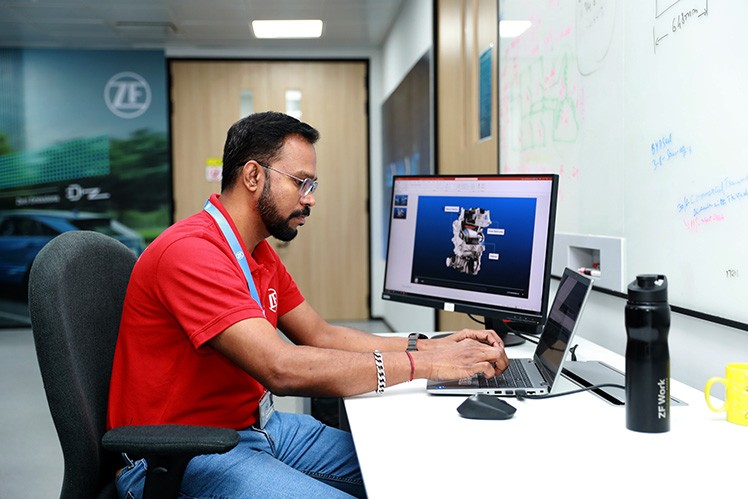
“Our future products are all practically inside my computer”, the engineer explains.
Experience Accelerates the Transformation
The speed with which ZF is driving the transformation to Next Generation Mobility impresses the head of the “ZF TCI Systems, E-Motor and Innovation” department: “More has changed over the past six years of my being at ZF than I’ve experienced in the 15 years or so of my career previously.” The company benefits from knowledge that has been built up over decades in the development of automotive components. Our experts have a deep understanding of which test procedures need to be incorporated into simulations, which parameters need to be considered and which test designs lead to valid results. “We also benefit from our many years of experience in the physical testing of gearboxes when it comes to the virtual validation of electric drive units,” explained Deevakar. “And that’s the upper hand we have over many of our competitors.”

The engineer is observing a paradigm shift: “For a long time, technological developments were transferred from aerospace via aviation to automotive engineering. That has changed. Innovations such as virtual releases, simulations and digital twins have their origins in the automotive industry. They also set new development standards for other sectors,” he explained. Deevakar has no doubt that ZF has played a decisive role in this. “I spent 13 years at a competitor that mainly manufactured mechanical components such as clutches and transmissions,” he said. “So, I was well aware of the high technological level of ZF products such as the 8HP or 9HP transmissions. But at the time, I could hardly have imagined how the company would continue to change in recent years – including through acquisitions – and what a wide range of solutions, systems and components ZF could supply.”
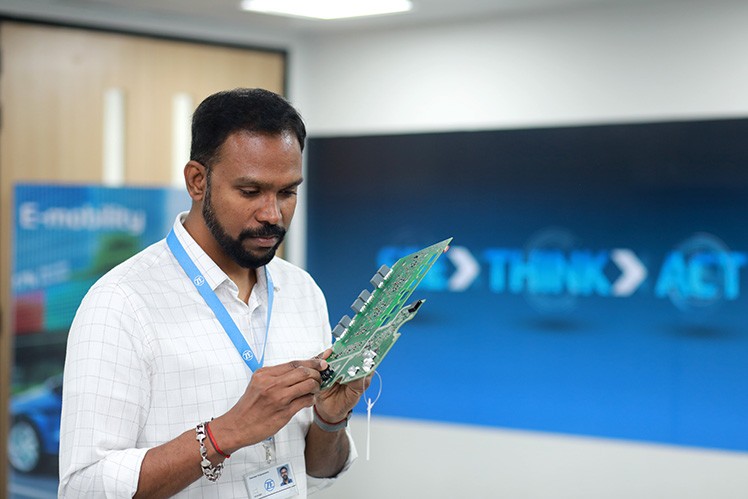
Deevakar Kuppuswamy is impressed by the speed in which ZF drives transformation.
Hyderabad: Center of Competence for Simulation
Deevakar also appreciates the global approach: “I work in an international team with colleagues who are scattered across several locations. But the ZF Competence Center for Simulation is in Hyderabad. Design changes made in Germany are immediately validated virtually in TCI Hyderabad. That's what we do best,” he said proudly. Concurrently, ZF is driving forward the localization of technical solutions: “We adapt the specifications depending on the market or industry in which our products are used,” he described. “At the same time, we also take different requirements into account in the parameters of our simulations.”
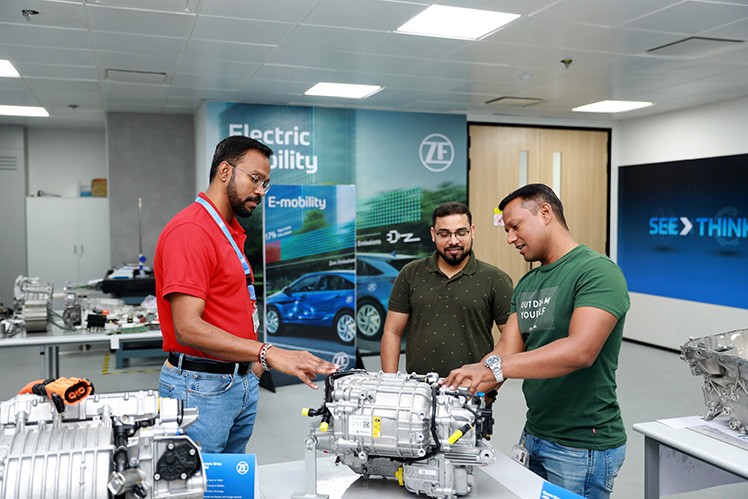
Together with his team, Deevakar Kuppuswamy ensures that many more people in India have access to mobility than before.
For example, the criteria for vehicles that are used exclusively in subtropical regions are different from those that have to withstand temperatures between minus 25 and plus 40 degrees. Deevakar is still fascinated by mechanics: “Only with motors, steering systems, brakes, axles and wheels can we ensure that many more people in India, in particular, have access to mobility than before.” Deevakar sees himself as a FutureStarter, as he and his team are helping to ensure this happens in a particularly sustainable and efficient manner.
What Exactly Does ZF Do?
We are designing the vehicle of the future. In this process, the focus is on our team, our #FutureStarters. Every day, they are developing technologies – from sustainability, electric mobility and autonomous driving to software, digitalization and vehicle motion control.