
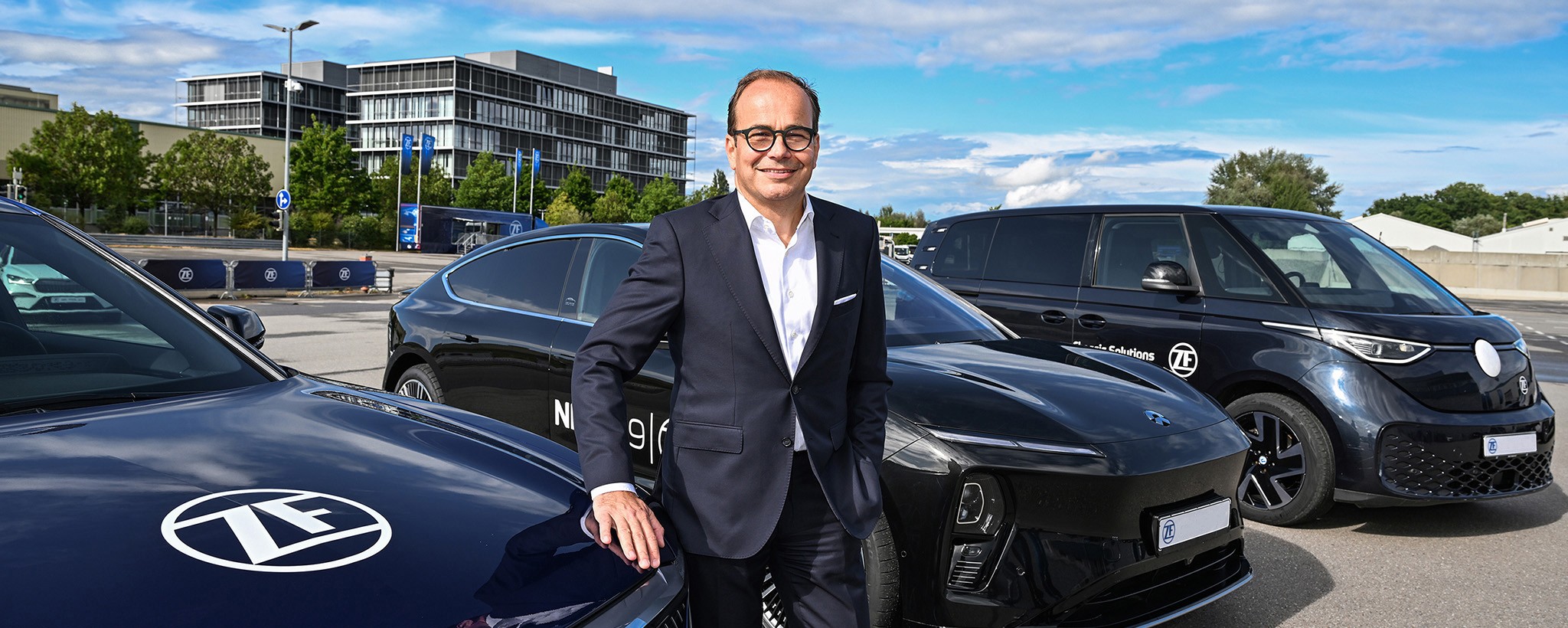
CTO Interview: “Engineering the Future of Mobility”
The ZF Supervisory Board has appointed Dr. Peter Holdmann as Chief Technology Officer (CTO). The newly created role underscores the strategic importance of technology and development for the Group’s innovative capacity and economic success. As a member of the ZF Executive Board, Holdmann is already responsible for Research and Development (R&D).
In this interview, Holdmann outlines ZF’s R&D mission amid a rapidly transforming mobility landscape. He shares how AI is reshaping engineering, how ZF is preparing for the Software-defined Vehicle, and how initiatives such as Chassis 2.0, electrification, and decarbonization are strengthening the company’s competitive position and shaping the future of mobility.
Dr. Holdmann, as CTO you recently took over responsibility for ZF’s global Research & Development organization. How would you describe ZF’s R&D mission today?
With the introduction of the CTO role, ZF is clearly underscoring the strategic importance of technology and innovation for our long term competitiveness. My mandate is to sharpen the company’s technological direction across all divisions and to ensure that research and development are globally aligned, efficient, and strongly customer focused. It is mandatory that our products are competitive, but the same is true of our development processes.
ZF is entering a decisive phase of transformation. Our R&D mission is therefore clear: we develop technologies that make mobility cleaner, smarter, and more efficient, and we do so with economic discipline and speed. Our innovation agenda is guided by three key trends: AI-driven engineering, the Software-defined Vehicle and decarbonization. These areas reflect both global market demand and ZF’s strength as a system integrator and technology leader in intelligent motion systems.
How is ZF using AI in its engineering processes?
AI is becoming an indispensable tool in our engineering processes. It helps us shorten development cycles, increase simulation quality, and improve predictive system behavior. This is essential when dealing with complex architectures like electrified drivetrains or multi‑actuator chassis systems.
AI allows our teams to optimize parameters early in the development phase, enhance virtual validation, and automate calibration processes. As a result, innovations – whether in electric powertrains or Chassis 2.0 technologies – reach series maturity faster, with higher precision and reliability.
AI doesn’t replace engineering, it amplifies it. It enables us to deliver better products in shorter timeframes, which is crucial in a global mobility market undergoing rapid change.
How is ZF preparing for the era of the Software‑defined Vehicle?
The Software‑defined Vehicle (SDV) is redefining how value is created in the automotive sector. Software is becoming the central orchestrator of vehicle performance, safety, comfort, and continuous updates.
ZF is strong in system integration and software competence, which are critical for the SDV. Our ability to harmonize intelligent actuators – steering, braking, damping – via advanced software frameworks enables OEMs to achieve consistent brand‑specific driving characteristics and faster calibration cycles.
This is why our Chassis 2.0 innovations are so important. They bring together advanced mechatronics, smart sensors, and software intelligence to make chassis systems more adaptive, efficient, and responsive. It’s a transformation from mechanical components to fully networked, software‑enhanced systems – already proven in series applications with leading global manufacturers.
Could you please explain the Chassis 2.0 approach in more detail?
Chassis 2.0 is one of our strongest innovation pillars. It transforms the chassis from a mechanical subsystem into a fully networked, intelligent system. We are already delivering road‑ready technologies such as steer‑by‑wire and brake‑by‑wire solutions that remove mechanical linkages and enable higher precision, new vehicle architectures, and enhanced safety.
Manufacturers from traditional OEMs to fast‑growing Asian brands have adopted our technologies. Think of our partnerships with NIO and Mercedes-Benz, for example. In both cases, we integrate our latest steer-by-wire expertise into the flagship models – as a bespoke solution tailored to the respective vehicle architecture and brand character. This breadth demonstrates how well ZF’s system expertise aligns with global market demands.
What sets ZF apart is the combination of component leadership, system‑level know‑how, and deep software integration. No other technology supplier offers this combination at scale.
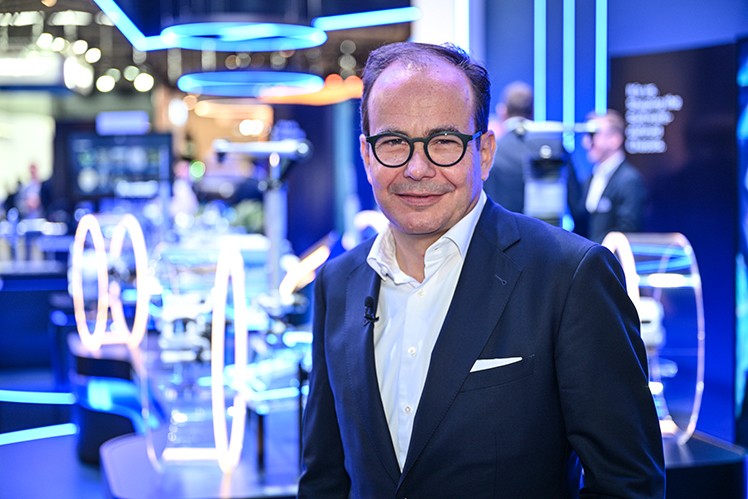
Dr. Peter Holdmann, Chief Technology Officer of ZF
From AI driven engineering to the Software-defined Vehicle, we’ve discussed key technology trends shaping ZF’s R&D mission. As sustainability becomes a defining priority for the industry, what role does decarbonization play in ZF’s technology and innovation agenda?
Decarbonization is a core design objective for ZF, and from an R&D perspective our focus is clearly on reducing the product carbon footprint across the entire lifecycle.
We have two major technological levers. The first is efficiency. Improving efficiency in the use phase has always been central to ZF engineering – from the 8HP transmission to our broad electrification portfolio today. Higher drivetrain efficiency, intelligent energy management, and system‑level optimization directly reduce vehicle CO₂ emissions.
The second lever is materials. We are significantly increasing the share of sustainable and recycled materials in our products. This requires rethinking designs from the outset to enable higher recycling content without compromising safety or performance. Closely linked to this are circular business models such as remanufacturing, reuse, and recycling – both enabled through product design and increasingly realized by ZF itself.
Decarbonization also means responsible substance management. A key example is PFAS (Per and Polyfluoroalkyl Substances), which refers to a large group of industrial chemicals that are increasingly viewed critically due to their environmental and health impacts. PFAS management is embedded at ZF as a continuous, organization wide activity linking Corporate R&D and the divisions. With our THERMAS thermal management system for electric and hybrid vehicles, for example, we already offer a PFAS‑free solution based on propane as a refrigerant. Similar efforts apply to critical materials such as rare‑earth magnets, where we focus on material efficiency and alternative concepts.
Overall, ZF approaches decarbonization holistically – through efficiency, sustainable materials and circularity, and responsible technology choices – supporting our customers’ climate targets while safeguarding competitiveness.
If you had to summarize ZF’s innovation identity in one message, what would it be?
ZF stands for intelligent technology – solutions that are efficient, connected, software enabled, and production ready. Our technologies are not distant visions; they are already shaping vehicles on the road and products in the field and on the oceans.
With our leadership in electrified powertrain systems, our system integration strengths for the Software‑defined Vehicle, our Chassis 2.0 portfolio and our AI‑driven engineering capabilities, we are positioning ZF at the forefront of a rapidly transforming industry.
And we are doing so with one clear ambition: shape future technology and remain on the winning side of the transformation, because we are truly driven by dynamics – in terms of technology, markets, customers, products. I could think of a no more exciting time to step into the role of CTO!