


A New Take on Thermal Management
ZF has built a reputation for delivering efficient propulsion systems in electrified mobility. Its advanced thermal management system, TherMaS, is another key to unlocking greater range from each battery charge.
What do drivers and electric vehicle technology have in common?
Both are at their best when kept cool in summer and warm in winter. Of course, everyone’s idea of comfort is a little different. Key vehicle components, such as the sensitive lithium-ion battery and power electronics, prefer temperatures between 15°C and 30°C, while the electric motor can tolerate up to 60°C. The battery needs to be either cooled or heated depending on the season, but the electric motor and power electronics always require cooling.
In both plug-in hybrids and battery-electric vehicles, intense summer heat and harsh winter cold influence electron flow, accelerate component aging, increase energy consumption and reduce the maximum possible battery range. Regardless of external conditions, the vehicle’s thermal management system is responsible for controlling heat distribution – serving both the technical components and the climate control of the cabin.
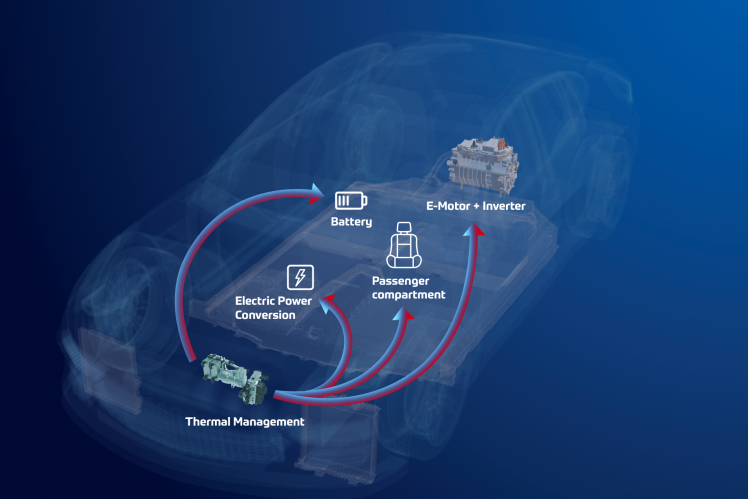
ZF engineers have completely rethought thermal management, simplified the technology and made it more compact and environmentally friendly.
Strong Growth for Thermal Management Systems
With the rapid adoption of electric vehicles, the global market for thermal management systems is expected to grow significantly in the years ahead. According to market research firm Global Market Insights, for example, the thermal management systems market is projected to grow at a compound annual growth rate (CAGR) of more than 16 percent between 2025 and 2034. Given these prospects and the close connection between electric driveline components, such as the electric motor, power electronics, inverter and converter, and the thermal management system, ZF decided to develop its own temperature management system. The developers set an ambitious target – to outperform all existing solutions on the market across several key dimensions.
As early as 2023, ZF engineers presented the first version of their TherMaS system in the EVbeat prototype vehicle. "Since then, we’ve made significant technological leaps," says Dr. Otmar Scharrer. He adds, "Thanks to its superior capabilities and easy-to-integrate design, our OEM customers can expect better performance from the electric driveline and increased electric range." Dr. Scharrer is Head of Development for ZF’s electric mobility product portfolio.
More Than Just a Range Boost
In challenging winter conditions, TherMaS can extract up to one-third more range from the drive battery – even in sub-zero temperatures – compared to today’s competitor systems." Beyond that, TherMaS offers several other key benefits for customers:
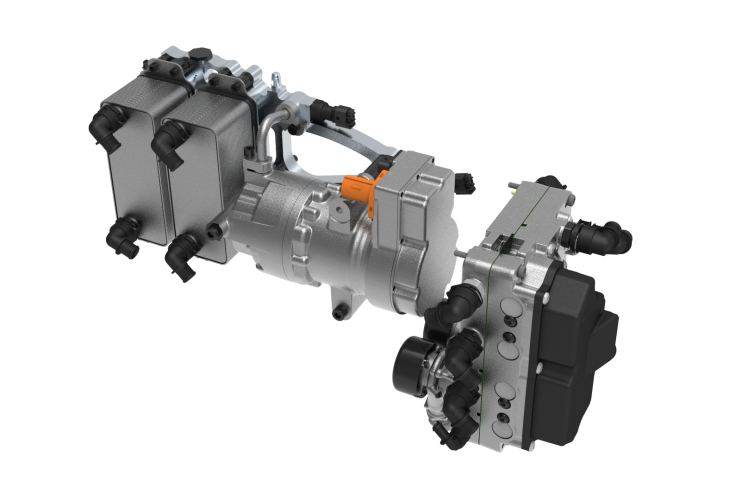
The heat pump and fluid control unit (on the right) from TherMas require less installation space and can be placed more flexibly in the vehicle.
- Thanks to its compact design, the system takes up minimal space, which is crucial given the limited installation room in modern vehicles. The compact dimensions also enable greater flexibility in positioning the heat pump and fluid control unit (FCU), e.g., closer to the passenger cabin or near components with high thermal demands. As a result, line lengths can be minimized, which reduces heat and cold losses and enhances the overall efficiency of the thermal management system.
- Thanks to its high degree of component integration, TherMaS can be installed more quickly than conventional systems.
- This, along with the system’s pre-filled refrigerant, simplifies and speeds up installation for customers. This helps lower its overall cost.
- There are plans to offer TherMaS in three performance classes. Its modular design accelerates integration into a wide range of vehicle platforms.
- TherMaS is exceptionally sustainable, using the natural refrigerant propane (R290) in a quantity of less than 150 grams.
"Thanks to all these benefits, TherMaS allows automotive manufacturers to boost range without necessarily turning to more efficient electric motors or larger battery packs – solutions that typically increase vehicle costs. The use of our thermal management system creates additional flexibility," says Dr. Benedikt Schauder. At ZF, he leads the product development of TherMaS.
Propane Refrigerant: Sustainable and Efficient
One of the secrets behind the compact design of TherMaS lies in its smart use of propane as a refrigerant. Less than 150 grams of future-proof, natural propane (R290), which is exempt from the PFAS ban, are required – compared to the 900 grams of R1234yf still used by today’s top systems. The PFAS ban refers to the European Union’s planned prohibition or strict regulation of per- and polyfluoroalkyl substances (PFAS). In the streamlined TherMaS thermal management system, naturally flammable propane circulates safely within a fully sealed, hermetic refrigerant loop.
The strong interest from customers in the entirely reengineered TherMaS thermal management system is a clear signal to ZF’s development team that they are on the right track.