
Testing for Electric Drives in Transition
The current transformation has shattered much of the conventional wisdom in the automotive industry. These changes also include testing, i.e., the testing and validation of new products in the development process. ZF has adapted to these changes.
The notion of "testing" instantly conjures up a test bench with sophisticated test technology often fenced in by plexiglass or solid steel gratings as a safety precaution. Many test benches are designed as enclosed spaces, leaving a window and countless cables for the control commands and the flow of test data as the only connection to the test team. ZF has many such test benches that the technology company uses to put the function and reliability of driveline components or entire systems through their paces. "Up to now, it was mainly about ingeniously encapsulating the life of a car in this laboratory environment so that the complex real verification tests can later be as streamlined as possible," says Matthias Tögel, Head of Testing, Validation, Simulation in ZF's Electrified Driveline Technologies Division. One disadvantage of this traditional testing approach is that products can only prove themselves on the test bench once they have reached a very advanced development stage, usually from the A-sample prototype to the close-to-production D-sample.
Reality check later
At ZF, as in the entire automotive industry, developers use the V-model. This method originates from software development where, depending on the project progress, individual test steps take place in the V-shaped development process. In the classic V-model used by developers, the testing on the test bench is therefore toward the far end of the right side of the V, at a fairly late stage. This phase determines whether the design of a product chosen by the engineers has proven itself in practice, whether it meets all the requirements specified by the customer and whether it is ready for volume production release.

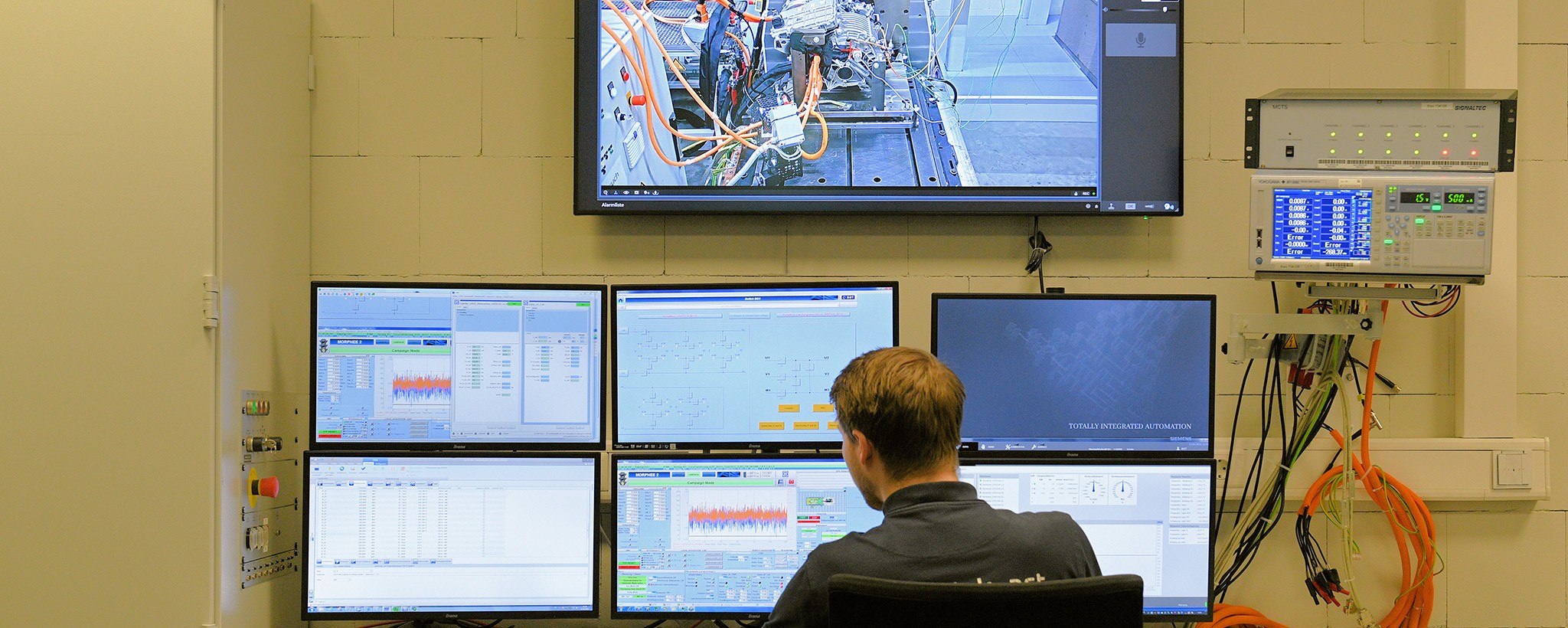
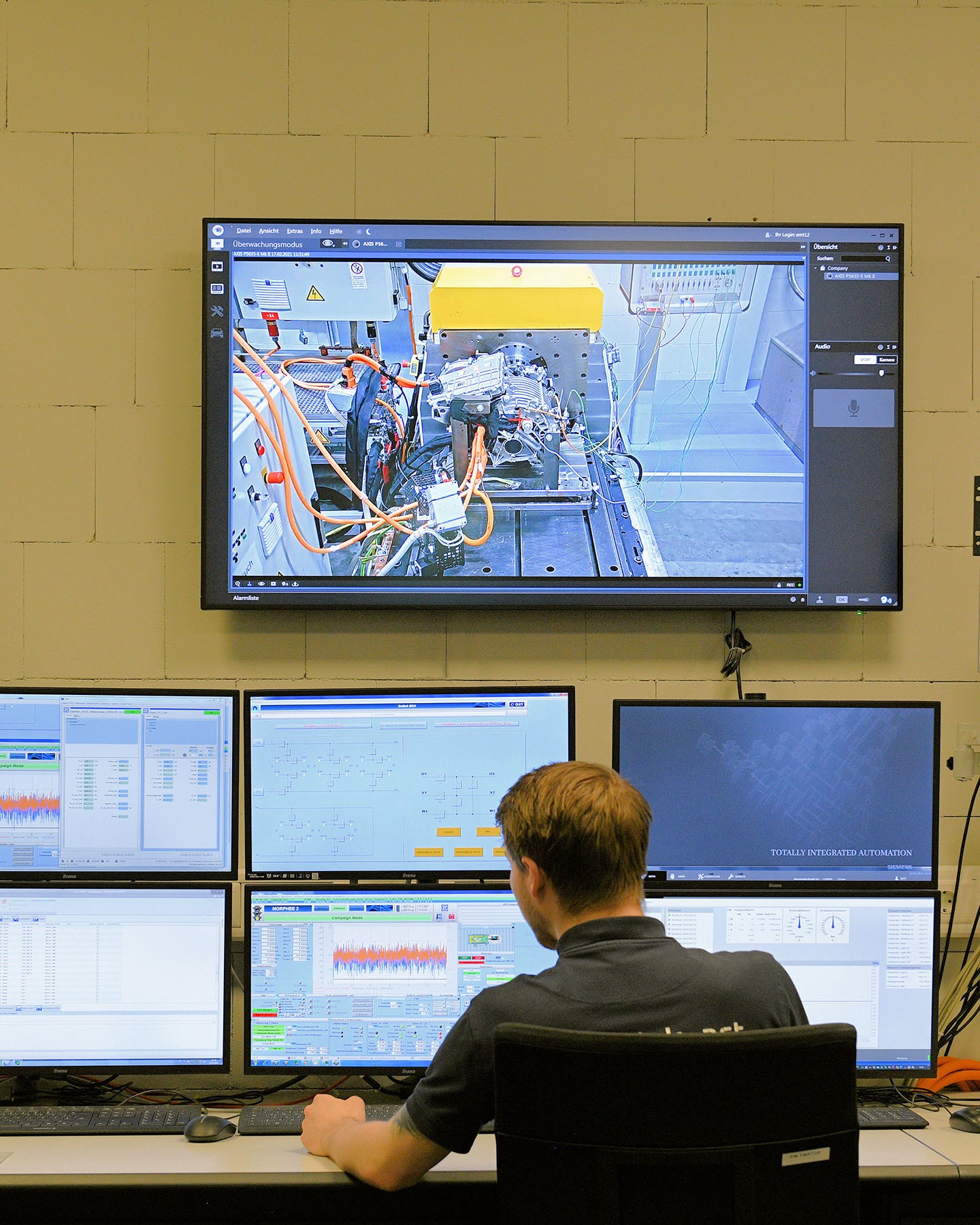
E-motor for performance measurement on the test bench
"In the future, the challenge will be to embed testing earlier on in the product evolution process. If we combine our testing know-how with our expertise in simulations, we can supplement or even replace complex and time-consuming test bench runs with simulations," says Tögel. The objective is to shorten development times and to reduce the number of prototypes and tests. So it entails getting faster and reducing costs. Especially in the Asian markets, a fast pace of development is now an essential selection criterion that automakers expect from a systems and development partner. Customers also demand digital twins of products from their system suppliers to streamline and accelerate their own tests for vehicle integration and to dispense with costly prototypes.
The rise of virtual testing
ZF can meet these expectations. To this end, the Group uses its extensive knowledge of simulation and physical tests. Planning has long been a key activity for testing experts. They have developed many of the test benches – in parallel to the product and based on the specific development specifications. "This was always done with the corresponding lead time," says Tögel, adding: "Because once the product is ready for the test phase, we cannot wait weeks or months to complete test benches."
Furthermore, the testing specialists at ZF are also developing virtual test procedures. They also embrace artificial intelligence (AI), with ZF already using AI algorithms that reliably identify the relationship between (thermal) system behavior and driving profiles. Tögel is convinced: "This triad of classic test benches, simulation methods and supplementary AI models is the future of testing." And that future has already begun. ZF developed a new cooling system for the electric motor for the high-performance EVSys800 drive, the heart of the ZF EVbeat concept vehicle. The engineers already derived virtual test methods from the simulation data in the design phase. This enabled them to determine the stable thermal behavior of the new powerful drive early on in the development process.
Another advantage the e-mobility specialist ZF offers is its ability to develop and test complete systems, such as how electric motors, power electronics and software harmonize. Their interaction affects the range of electric cars and how car manufacturers dimension expensive vehicle batteries. The use of ZF software alone increases the range of an electric vehicle by six percent.