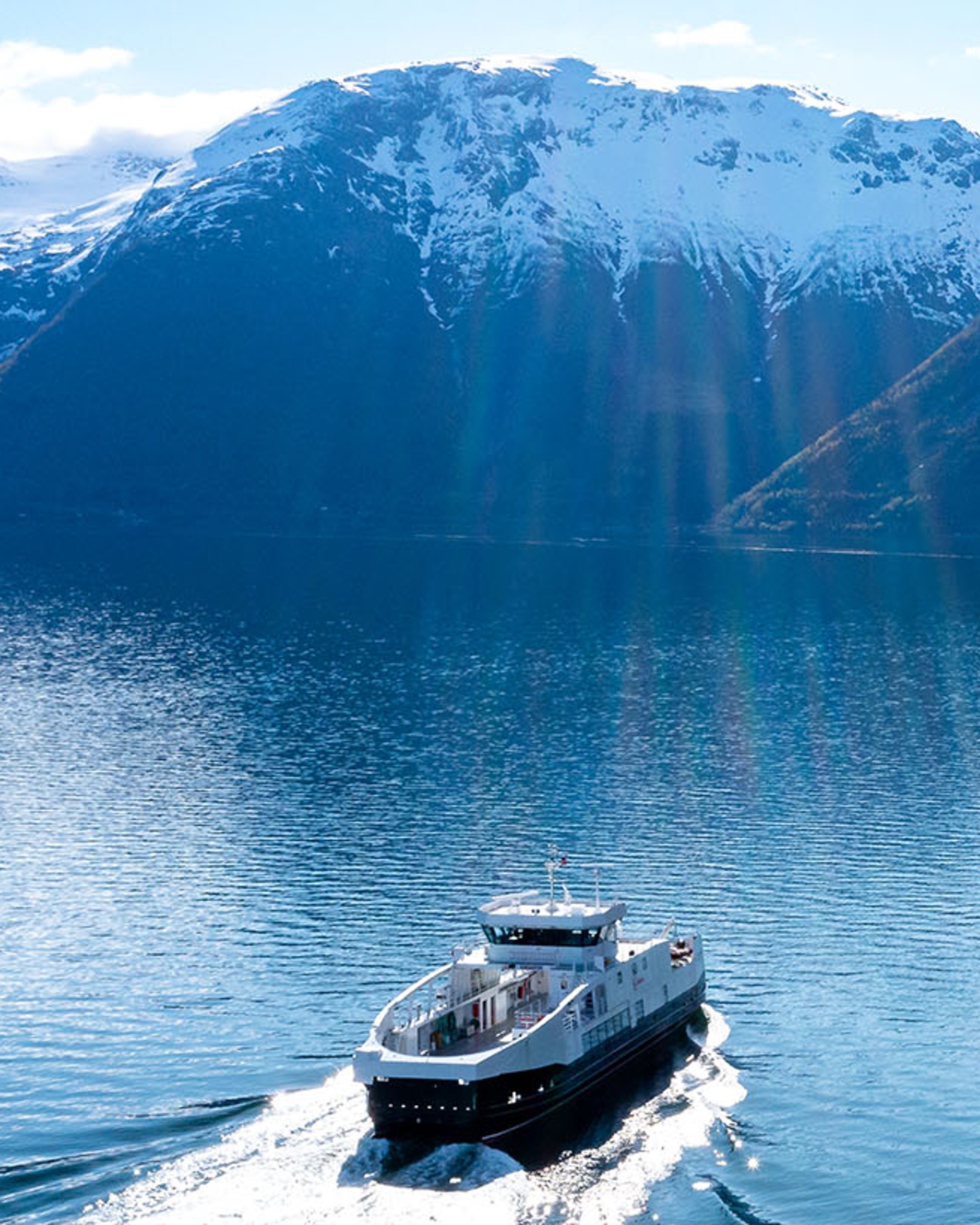
E-Ferries: Reducing the Ecological Footprint
The prevalence of shorter routes makes ferries the ideal electrification candidates. Eliminating diesel propulsion helps reduce greenhouse gas emissions. Learn more about the benefits of electric marine propulsion systems and the role ZF plays in advancing them.
Anyone following the current public discussion about the role of transport as a greenhouse gas polluter is led to believe that it is all about passenger cars and commercial vehicles. Shipping barely gets a mention. It accounts for around 2.5 percent of carbon dioxide emissions worldwide. Within the EU, according to figures from the European Commission, it is as much as three to four percent. Because the Paris Agreement does not include shipping, the UN's International Maritime Organization (IMO) is to develop regulations to reduce greenhouse gas emissions. In July 2023, the 175 IMO member states agreed to change their original strategy.
Now it includes the target of net-zero emissions from ships by or around 2050. IMO Secretary General Kitack Lim said in this respect: "The adoption of the 2023 IMO Greenhouse Gas Strategy is a monumental development for IMO and opens a new chapter towards maritime decarbonization. At the same time, it is not the end goal, it is in many ways a starting point for the work that needs to intensify even more over the years and decades ahead of us."
Win-Win Situation for All Involved
If electrification is an important solution for more climate protection in cars, this only applies to ships to a limited extent. For them, the "battery-electric drive" can be leveraged particularly for vessels that tend to cover short distances. Many ferries fall into this category. However, electric ferries not only help reduce carbon dioxide emissions. They also improve air quality for local residents at the ports of call and reduce noise. But the operators of e-ferries also benefit from the new technology. According to the Argonne National Laboratory, a research center in Washington D.C. that is part of the U.S. Department of Energy, it is cheaper to maintain electric motors and batteries than a propulsion system with combustion engines. Since modern batteries can be recharged in 10 to 15 minutes, the time spent in port is sufficient for recharging energy. Of course, the bill for the environment only adds up if the electricity in the port is generated from carbon-neutral sources.
Growing Market for Maritime Electric Drive Technology
In view of the requirements to massively cut carbon dioxide and the advantages of maritime electric drive technology, this technology has a bright future. According to Business Norway, which describes itself as Norway's official marketing platform for sustainable solutions, the global market for electric ships is expected to reach $14.2 billion by 2030; in 2022, it was just $3.3 billion.
Currently, 586 battery-powered ships are in use worldwide, according to the Maritime Battery Forum in February 2023. Nearly 200 more are on order. Norway itself is a pioneer in electrification, not only in road transport but also in shipping. With the Ampere, the country put the world's first fully electric ferry into service in 2015. Since then, the 80-meter catamaran has been traveling back and forth across the Sognefjord up to 35 times a day with up to 120 cars and 350 passengers. Today, around 80 fully electric or hybrid-electric ferries operate in Norway.
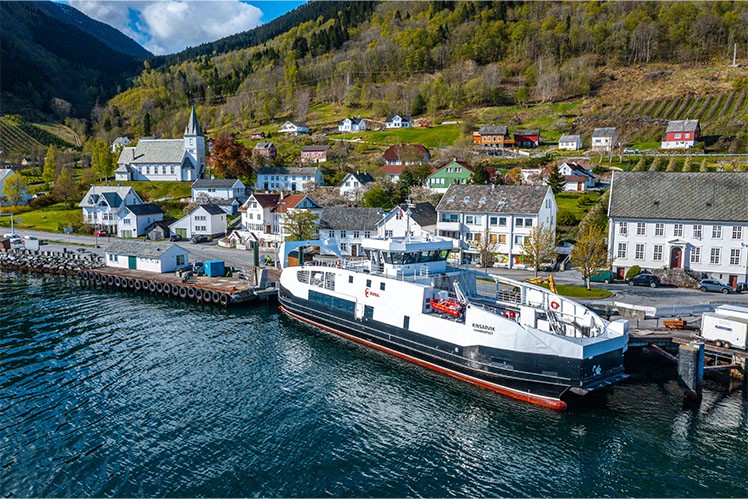
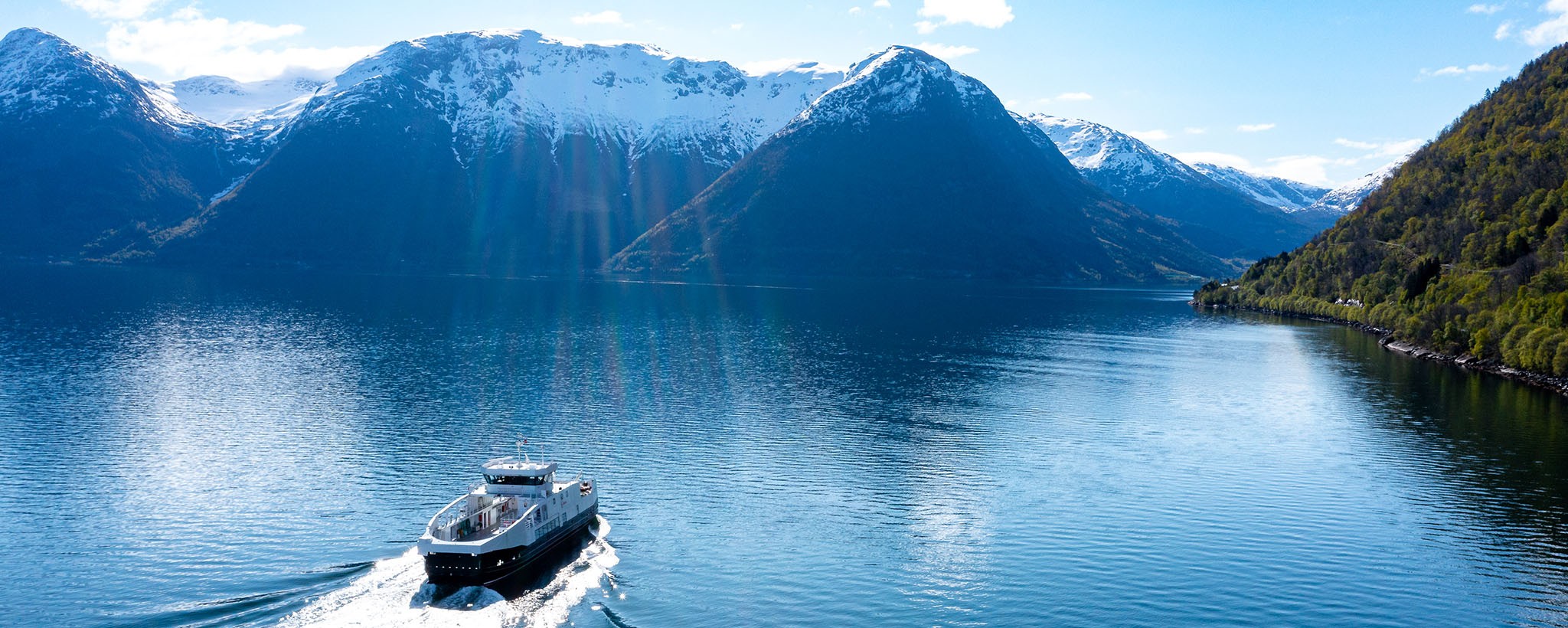
The Norwegian catamaran ferry Kinsarvik with its two thrusters from ZF uses the docking stops to recharge the batteries.
Quiet Through the Water in Norway's Natural Landscape
Among them is the Kinsarvik. Like its fledgling forebear, the Ampere, the 45-meter-long Kinsarvik is also a catamaran with an aluminum hull, offering space for 16 cars and 80 passengers. Since the beginning of 2020, it has taken over the ferry service between the villages of Kinsarvik and Utne in southern Norway. Along the road skirting the fjord, the two places are 90 kilometers apart. With the ferry it is only eight kilometers. Although the Kinsarvik covers this route fully electrically in standard operation, it still has two diesel engines and generators onboard for emergencies.
The local power grid does not support direct fast-charging of the ship's batteries. Hence the Kinsarvik draws power from two buffer battery packs at the terminals once it has docked. The battery packs are then recharged more slowly. Compared to a ferry with a diesel engine, the carbon dioxide backpack of the Kinsarvik is 92 percent smaller. ZF's driveline technology is responsible for this.
Under the motto "Next Generation Propulsion", the technology company has a comprehensive product portfolio for a wide variety of marine applications – whether conventional, hybrid or all-electric. A common feature of all components and systems: drive solutions in various sizes through to a power range of up to 12,000 kW. In the case of the Kinsarvik, two ZF AT 3016 WM-CR thrusters provide the propulsion. A thruster is a pod that can be rotated 360 degrees below the hull with one or two propellers. The electric motor that drives the propellers sits inside the hull.
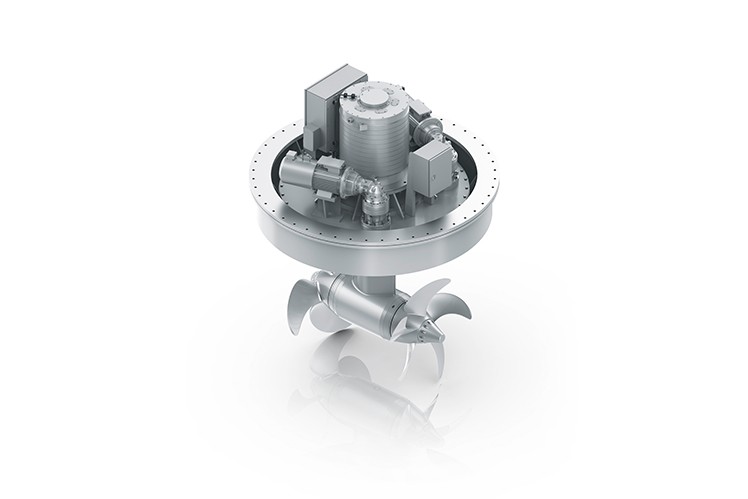
Two ZF AT 3016 WM-CR thrusters make the ferry in Kinsarvik, Norway, efficient and manoeuvrable.
On the ZF AT 3016 WM-CR thruster, a pulling propeller operates at the front of the pod while a pushing propeller operates at the back. Both rotate in opposite directions. This arrangement and a new propeller design put less strain on the blades, which benefits the service life. The lower load also reduces noise and vibrations. At the same time, it also increases maneuverability and ride comfort. Thanks in no small part to the double propeller design, smaller propellers can be installed, as the power is handled by two propellers instead of a conventional single propeller.
Transporting Lisbon's Commuters Electrically
Electric ferries with ZF technology also ensure shorter distances at the western end of Europe, in Portugal. Lisbon-based ferry operator Transtejo ordered ten fully electric passenger ferries from Spanish shipyard Astilleros Gondán in October 2020. These plastic-hull catamaran ferries replace ten diesel-powered ferries from the current Transtejo fleet of 28 vessels. They are used on three of the five Lisbon ferry routes across the Tagus estuary. The electrification of the ferry fleet makes an important contribution to the Portuguese Government's national plan to become carbon-neutral by 2050.
The first of the ten electric ferries was delivered in March 2023. Her name the Cegonha Branca (White Stork). By the end of the year, there were four in operation, with the remaining vessels following in 2024. "An electric battery ferry is a zero-emission option for commuters who may instead have to take a car across a bridge in gridlocked traffic," says Elise Sturrup, a marine researcher with the nonprofit International Council on Clean Transportation. This is exactly the situation in Lisbon where a route runs alongside the city's landmark, the world-famous "Bridge of the 25th April." This route is served by one of the e-ferries.
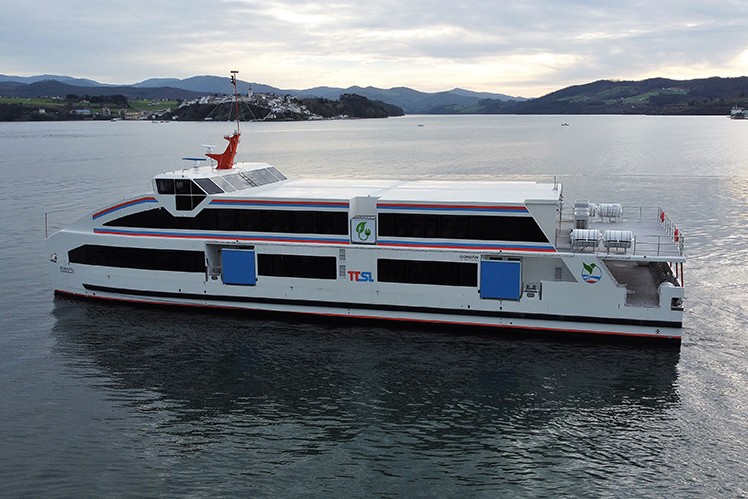
Since 2024, ten fully electric ferries have been transporting passengers across the Tagus River in Lisbon with zero emissions.
Like its sister ships, the 40-meter-long and twelve-meter-wide Cegonha Branca can transport 544 commuters. For each of the two 550 kW electric motors of each ferry, ZF supplies two ZF 3055 NR efficiency-optimized transmissions, each configured according to customer specifications.
The transmissions are specially designed for electric drives with improved efficiency. Thus, ZF offers an optimal solution for the growing market of electrically powered ships.