

Enabler, Guide and Pacemaker: AI at ZF
ZF doesn't limit its use of AI and machine learning to specific products. The entire portfolio benefits from artificial intelligence, which also contributes to faster and more efficient processes within the Group.
Artificial intelligence has been present in the automotive industry for many years, including at ZF, long before language models like ChatGPT or image generators like DALL-E became popular. Highly automated and assisted driving relies on AI algorithms. But the potential of AI goes beyond that. When used correctly, AI is an important enabler and success factor.
AI Speeds up Path to Marketable Products
“AI is of strategic importance for ZF because it helps us to redesign and optimize our products and development processes and develop more efficiently” explains Torsten Gollewski, Executive Vice President Corporate R&D Innovation & Technology. And not just in terms of software for driving or assistance functions. Engineers across the Group are exploring how AI can play an important role in developing and designing ZF products made of copper and steel. Here, AI can shorten the development cycles. AI can also optimize logistics processes, spanning the entire value stream of the production chain – from the supplier, the ZF plants, all the way to delivery to customers.
Accelerating Development Processes
The AI Tech Center in Friedrichshafen, anchored within Corporate Research and Development, plays a significant role in this. This trend is evident across various industries, where generative AI leads to significant cost savings in development. Generative AI can be particularly helpful in accelerating and streamlining the development process when creating artifacts such as requirement specifications, design drawings, layouts and code. "This is why the validation of AI-generated results by the developer will be even more important in the future," explains Dr. Manuel Götz, who heads the AI Tech Center.
In a large, globally active group like ZF, significant development time can be saved during the initial project phase by systematically analyzing customer requirements. "We see a lot of potential for AI in requirements analysis and management," explains Götz. There is an internal pilot project for this purpose. It identifies recurring or similar requirements in customer requests. This allows engineers from different ZF divisions not only to find similar elements in recent requirements specifications but also to see how they were handled. "Developers gain access to code, test specifications and other tools that can also be utilized for the new project – even if it's just to make the estimates faster and more reliable," says Götz. AI thus facilitates the sharing of expertise and unlocks additional benefits.
AI algorithms can also make the later stages of development projects faster and leaner – testing and validation, for example. There has been a longstanding trend to support or replace complex and time-consuming hardware setups with simulations. However, even the simulations are quite complex, as they require extensive programming based on a mathematical-physical model. "It will be cheaper and more efficient if we use AI algorithms as non-linear approximators, provided there are sufficient amounts of data," explains Dr. Tobias Ehlgen , Head of AI Systems & Control. In this way, AI agents can orchestrate the validation of product designs and reduce development time as well.
Fields of Application of AI in Development

Connecting AI with ZF's Core Business
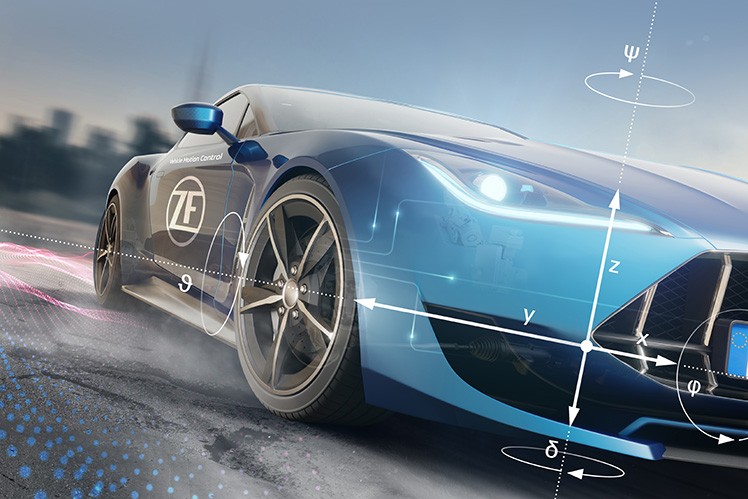
There are, of course, other ZF products where AI comes into play. "In our core business, we combine our vast expertise and experience with AI approaches – and gain competitive advantages in this way," explains Götz. One example is the cubiX control software. It interlinks and coordinates the active and semi-active actuators with a control algorithm for all longitudinal, lateral and vertical dynamics controls in the chassis of a car. Many of these AD and ADAS functions also require predictive trajectory control, which means predicting where exactly the vehicle could move. This is where cubiX developers apply machine learning methods.
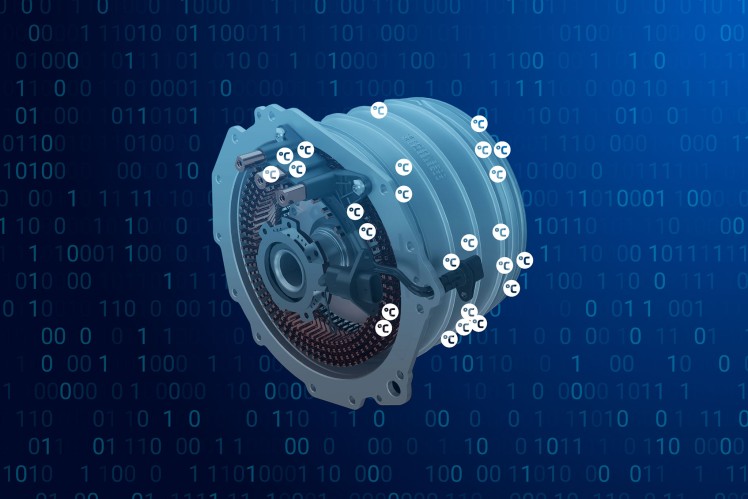
Another highly interesting field of application is virtual sensors. The control software of many ZF products requires data on temperatures, speeds and positions to ensure efficient operation. However, some of these parameters cannot be measured in real operation. For example, it is simply not possible to install a physical sensor in the highly dynamic interior of an electric motor's rotor.
Virtual Sensors and New Digital Business
Thanks to machine learning, the combination of hardware testing and AI evaluation, ZF developers can also obtain this information by having AI calculate it based on specific changes in environmental factors. "At ZF, the potential for applying virtual sensors is immense because our product range still heavily relies on mechanical components," says Götz. The temperature sensor in the rotor was just the beginning. Further projects are in the pipeline, where AI could take over the complex measurement of torque or friction values or calculate the service life of agricultural machinery transmissions from the utilization profiles. Further business models or service agreements could then be derived from the information determined in this manner.
The examples show that AI has already become an integral part of daily life at ZF, with the company firmly focused on adding and creating value. The AI Tech Centre picks up on ideas from the divisions or responds to their specific needs. This creates synergies, not only in terms of tools, processes and concrete applications, but also in terms of the framework. Ultimately, overarching topics such as cybersecurity, intellectual property and the ethical use of AI must also be consistently regulated throughout the Group.