

Automotive Software: How Open Source Is Powering the Future
A demonstrator from ZF shown at CES 2026 had it all: For the first time, safety critical automotive software was running on a central computer based on open source middleware — demonstrating the close integration between open source innovation and proven ZF technology.
A simple setup with big impact: From a bird’s eye view, you follow a car through the streets. The vehicle maintains a constant speed, brakes autonomously when obstacles appear, and then continues driving. What ZF showed at CES in Las Vegas was not a film, but a software in the loop setup. The real time control software was installed on a production ready version of the ZF Pro AI supercomputer. An Adaptive Cruise Control (ACC) system reacted exactly as a real vehicle would in an actual environment.
What made this setup special: The software on the ZF supercomputer was built on a central compute architecture — different from what is currently used in today’s production vehicles, where safety critical systems are typically integrated into decentralized controllers. In addition, the middleware serving as the interface between algorithms and direct steering and braking commands was based on Eclipse S CORE, an open source software.
High Maturity Level and Automotive Grade Safety Processes
“The most spectacular thing was that there was nothing spectacular to see — the functions simply ran smoothly, stably, and reliably,” says Gunter Bauer, responsible for open source software at ZF. The middleware used by ZF here is a key aspect of implementing the new electronic architecture and thus a cornerstone of the software defined vehicle. “Thanks to open source, middleware becomes available faster and in a more standardized way — which saves valuable development time both for us and for OEMs,” Bauer explains. “Quality and safety processes in open source software are now implemented in such a way that they can be used for all automated and highly automated driver assistance systems. We will be on the market with production ready concepts starting in 2027,” he concludes.
Middleware is a crucial topic for ZF because it forms the bridge between control software and the drivetrains, chassis systems, steering systems, and brakes for passenger cars that ZF develops and manufactures worldwide. These components will remain essential, even in the era of the software defined vehicle. What will change is how they are controlled. In the future, ZF aims, for example with cubiX, to offer pure software products in the chassis domain.
Strong Commitment to the Open Source Community
This is why ZF has been actively involved for years in projects, consortia, and the open source community. The CES demonstrator also emerged from such an initiative:
It is based on Eclipse S CORE, an open source platform advanced by ZF together with several partners under the umbrella of the Eclipse Foundation. The performance optimized architecture originates from Qorix, a company in which ZF holds a stake through a joint venture. In addition, ZF contributes to other open source projects such as Eclipse OpenSOVD, a standardized vehicle diagnostics solution for central computers.
For the demonstrator, ZF selected an operating system from Red Hat — a specialist well established in both the tech industry and the automotive world in the United States. “For us, the primary goal isn’t to directly contribute open source code; rather, we want to bring in our expertise as a partner to OEMs and connect the working groups and other players in the open source community to build a strong ecosystem,” Bauer explains.
Central Role of the Open Source Program Office (OSPO)
An Open Source Program Office (OSPO) plays a central role in this: It ensures that open source activities are strategically managed, legally secured, and implemented in a technically sustainable way. For projects like OpenSOVD, the OSPO typically handles tasks such as selecting and adhering to suitable licenses, coordinating governance with the Eclipse Foundation, managing the community contribution model, and providing internal guidance to development teams. In doing so, the OSPO creates the organizational and legal foundation on which developers and partner companies can collaborate efficiently and securely.
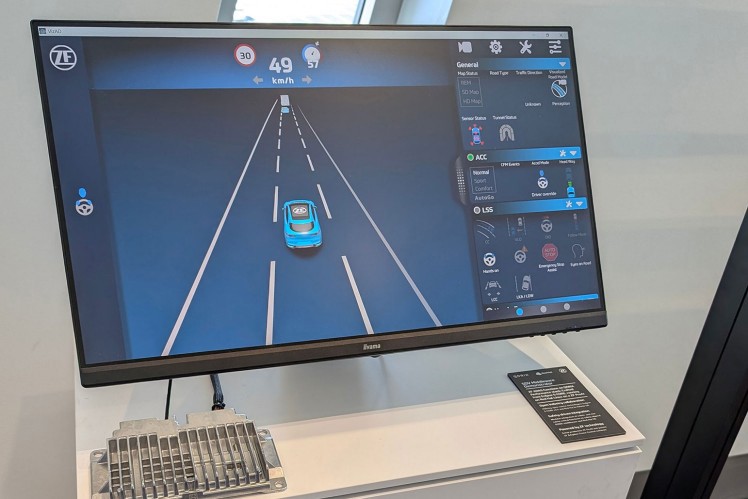
The core of the ZF demonstrator is the Qorix performance architecture, developed on the basis of Eclipse S-Core and integrated with the vehicle operating system from Red Hat. It runs on ZF Pro AI.